


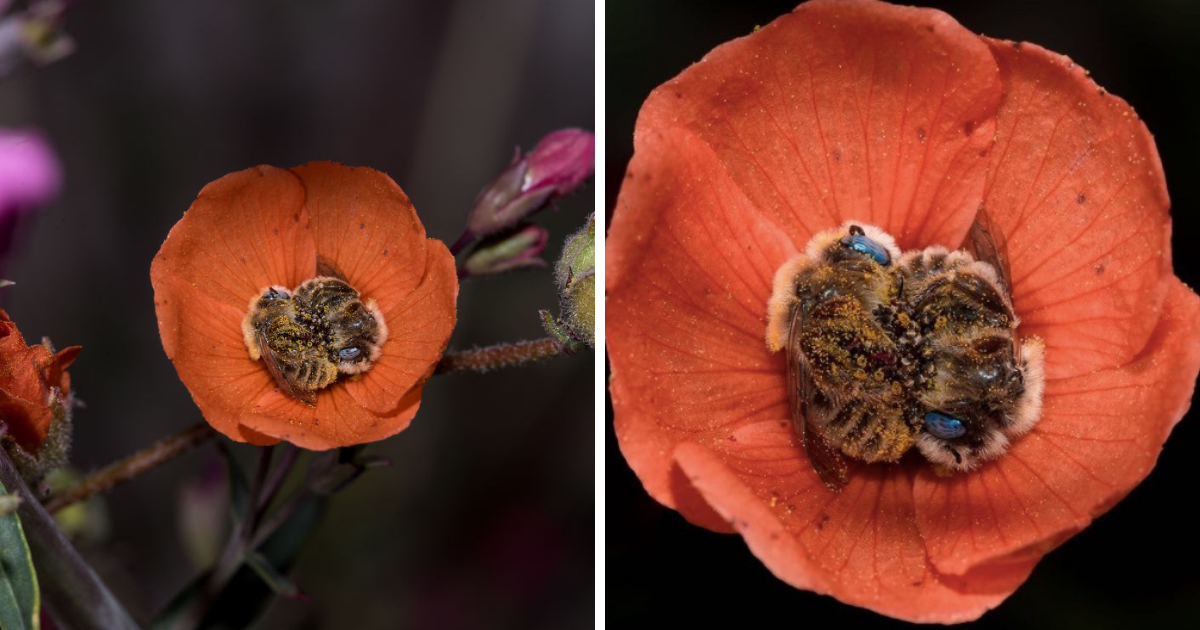


Have you ever seen a bee sleeping? Have you ever seen two bees sleeping?
Luckily for us, we’ll get to see these photos because a wildlife photographer happened to be at the right place at the right time.
View this post on Instagram
International wildlife photographer Joe Neely from Phoenix, Arizona was looking for a totally different member of nature when he chanced upon the sleeping bees.
“The story behind these photos [begins when] me and my fiancé Niccole went out to find poppy flowers,” Neely told Bored Panda. “On the way back we saw this patch of pink flowers just off the highway, so we stopped to take some photos.”
Niccole was taking photos of an orange Globe Mallow plant hidden inside the flowers when she heard some bees buzzing. That’s when she noticed the bees inside the flower.
View this post on Instagram
And she noticed that the bees weren’t moving.
“I came over and studied it for a while, and more bees showed up. Soon, all the vacant flowers were occupied, and this one bee was left out. She crawled over to this open flower and got inside with the other one. I was watching as he stumbled around almost drunk-like and then got settled in,” Neely shared.
View this post on Instagram
Although bees mainly sleep in hives, it is also common enough to find them sleeping in flowers.
Bees require at least 50 degrees Fahrenheit or higher to fly with ease without consuming their nectar stores. 80-90 degrees is actually more ideal for them.
And when the temperature drops, they tend to stay in flowerheads or deep flowers where it’s 18 degrees warmer than outside the flower.
The bees you’ll find inside a flower will most likely be female bees, especially if they’re alone. The temperature may have dropped significantly while they’re foraging. So they take refuge inside the flowers and save the nectar.
View this post on Instagram
Be careful when you see them in the flowers.
If you disturb the flower or the bee in the slightest bit, the bees will fly away. Joe was very careful about that because he understands the way nature works. That’s why he’s particular about the camera equipment he uses.
“I used a Nikon d750 and a 150mm macro lens along with an R1C1 Nikon macro flash,” Neely revealed. “I keep a respectable distance and don’t do anything that would change the subject’s behavior or distort the beautiful nature. How macro photography is different is that your depth of field is very small or shallow because you are very close to something so tiny. So because of this, I like to shoot with an aperture around f16 to f20, to get as much in focus as possible. This usually means there will be a need to introduce artificial lighting, like a flash. Now that may sound annoying, but the best part about using a flash is that you don’t have to depend on a fast shutter speed for sharp images. Instead, you are freezing all movement (yours and the subjects) with the speed of light.”
And we’re glad Joe was able to capture this moment.
We get to witness the natural actions of bees in their natural habitats.
View this post on Instagram
If you’d like to purchase Joe’s prints, you can do so here on his website. Don’t forget to follow his amazing work on Instagram.
Do you want to see more of Joe’s photos and bees? Watch the video below.
Please SHARE this with your friends and family.


