


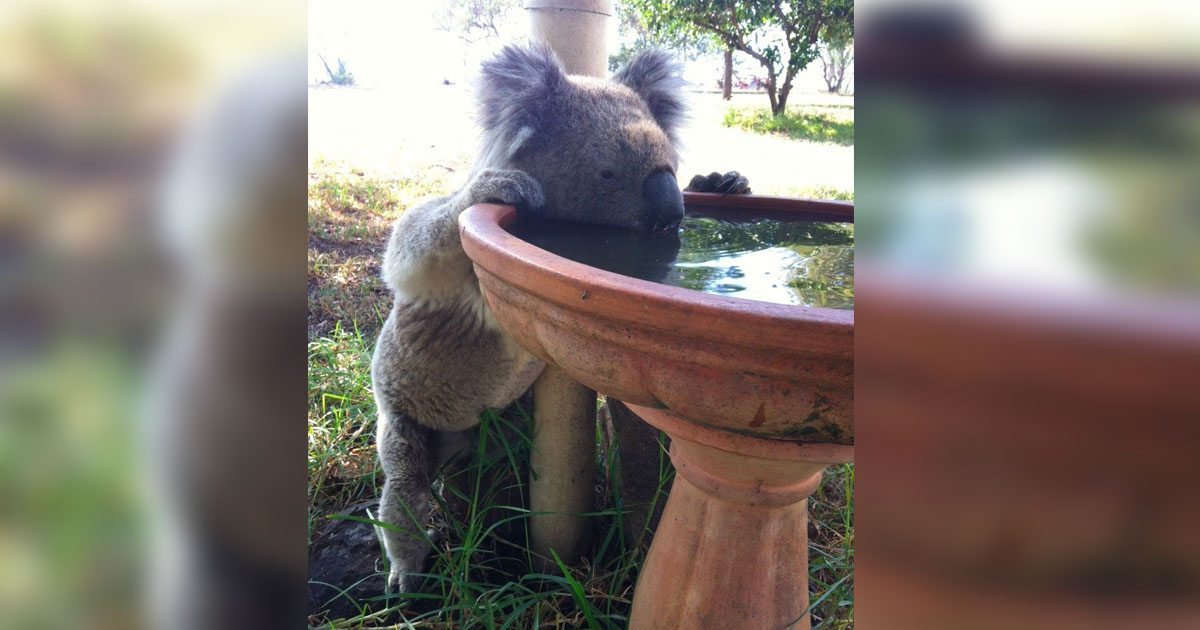




Researchers of from the University of Sydney have noticed that more Koala’s are drinking water. While this might seem like a perfectly common occurrence to most people – it could actually mean something quite serious.
Koala’s typically source their hydration from the eucalyptus leaves they eat which make up the majority of their diet. Now, with changing weather patterns and wildfires, their environment simply isn’t coping and they are forced to obtain their water from elsewhere.

Robert Frend – a farmer from New South Wales wanted to get involved. He invented the Blinky Drinker, which is essentially a water station that attaches to trees so that koala’s can hydrate themselves without putting themselves in dangerous situations or going without.
Ten drinking stations in a remote area were put under surveillance by the researchers to study the koala’s behavior and get an idea of how frequently they were using them.

They were shocked at just how much these koala’s loved the Blinky Drinkers. Typically, koalas sleep for the whole day, only waking up to eat. These koalas however were waking up during the day to find a drinking station. They found that between the months during fall and winter – when the heat isn’t severe at all – they were visited 193 times.
The researchers gathered that this behavior was them adapting to climate change, which raised concerns about how they would cope in the summer heat in other areas where Blinky Drinkers didn’t exist or water was scarce.
“Increasing hot and dry conditions will mean more droughts and heat waves affecting the koalas’ habitat,” said Dr Valentina Mella, a postdoctoral researcher who was conducting the study. “It is believed that koalas are particularly vulnerable to climate change because they rely exclusively on trees — not only to sleep on but also for eating, which together comprise of the bulk of their activities.”

A strong positive that has come from the study is the confirmation that the koala’s are willing and able to utilize the drinking stations in order to adapt and survive. They hope that these drinking stations could act as a lifeline for the 43, 000 koalas left in the wild.
“I’m a big kid too when it comes to koalas, I think they’re a lovely animal and I’d hate to see them disappear,” Frend told Reuters. “If I can help, well I get a certain amount of enjoyment out of that. Yeah, they’re a lovely species.”
“The scientific literature is filled with statements saying that koalas do not need to drink free water but our results show that koalas could benefit from water supplementation,” Dr. Mella said. “This is a perfect example of how the understanding of animal behavior can be applied to solve pressing problems. We hope to use our findings to create a practical plan to manage Australia’s rural lands for this iconic species.”
Please SHARE this with your friends and family.


